

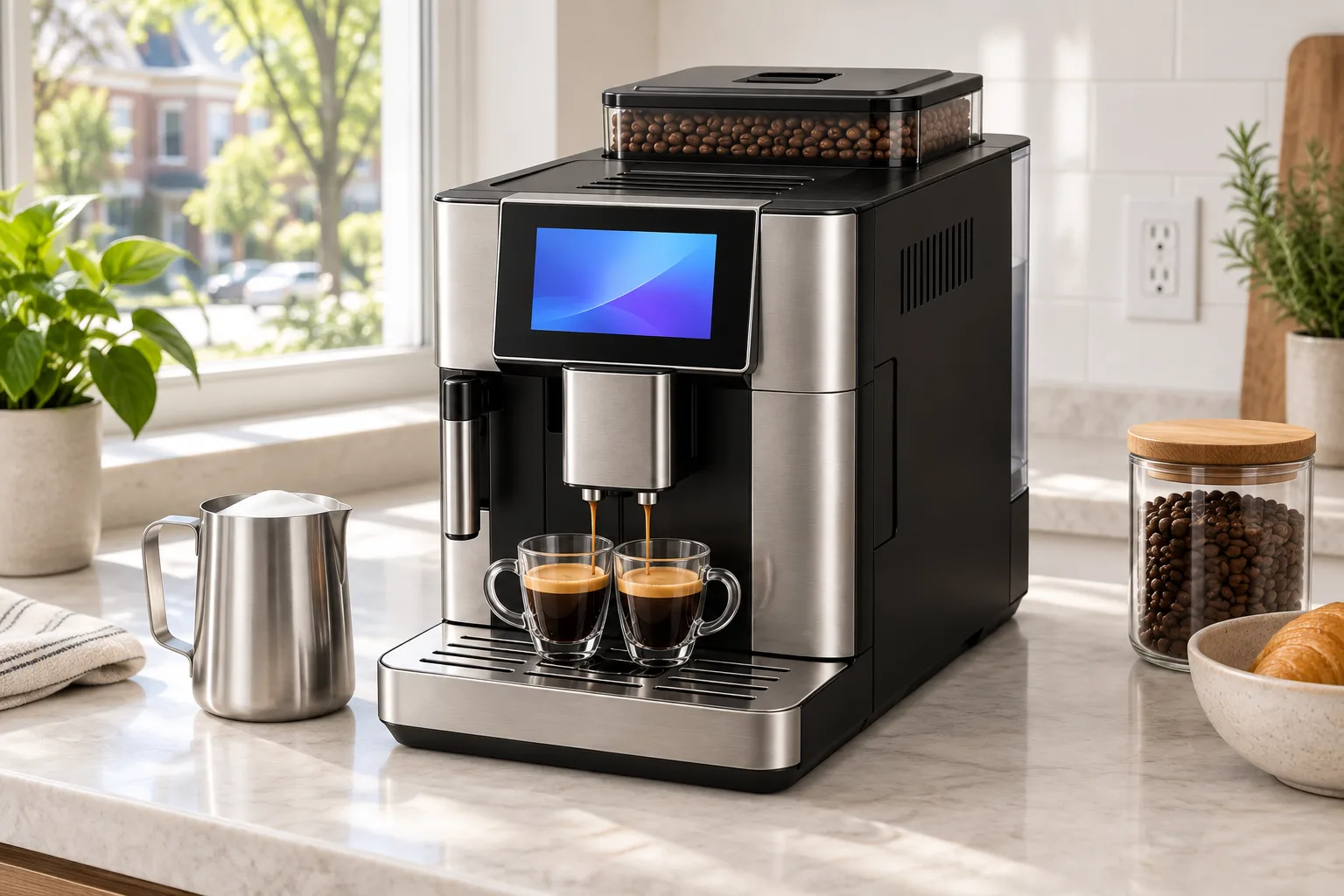
Espresso at home comes down to one choice: a machine that grinds, tamps and brews at the touch of a button, or one where you do those steps yourself. Both make good coffee. They differ in taste, in the minutes they take each morning, in the cleaning they ask for and in what they cost over a year.
We ran both side by side in our test kitchen for four weeks, timed every step with a stopwatch, held a blind tasting and did the math on beans, milk and upkeep. Here is what we found, without the coffee-shop jargon.
Two ways to make an espresso
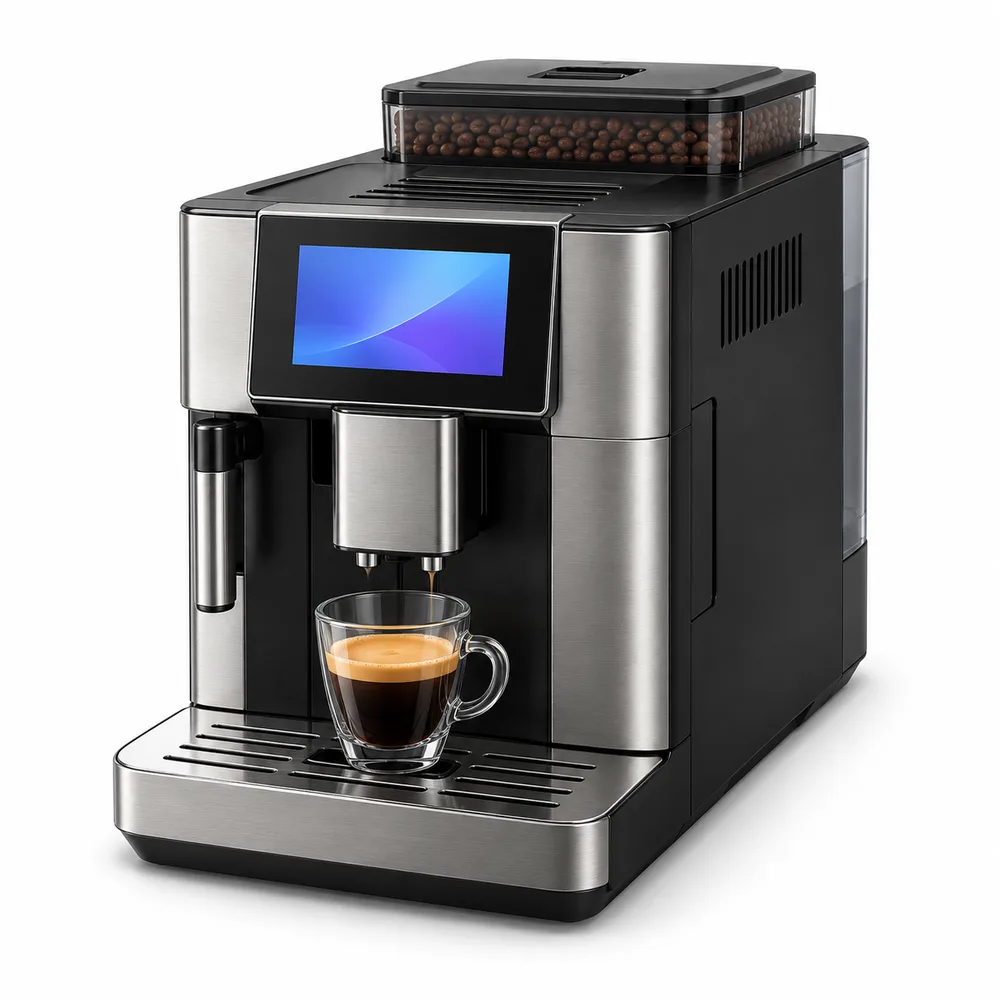
An automatic machine, like the Kaffio Barista 7, has the grinder built in. You fill the hopper with beans and the tank with water, choose a drink on the screen, and the machine grinds, presses the coffee, brews at 15 bar and froths the milk. The used grounds drop into a drawer.
A manual machine, also called semi-automatic, does the brewing and steaming; everything else is yours. You grind on a separate grinder, weigh the dose, tamp it into the portafilter, start and stop the shot, and steam the milk with a wand. Our manual setup was a mid-range single-boiler machine with a separate burr grinder, a scale and a tamper, about $900 together.
On the automatic, the 12 presets are where the convenience lives. Espresso, americano, cappuccino and latte each have their own button, and you can save the strength and cup size you like, so the second person in the house gets their drink without touching a setting. After every milk drink, the machine asks to rinse the frother; it takes ten seconds and saves a sticky job at the end of the day.
Taste: where a manual machine pulls ahead
Six people from our Chicago office tasted the drinks blind, in random order, over three mornings. We used two bags of beans from the same local roaster: a medium-dark blend and a light single origin.
- Lattes, medium-dark blend: four of six could not tell the machines apart; the other two split one each way
- Straight espresso, medium-dark blend: four of six preferred the manual shot, for its thicker body and longer finish
- Straight espresso, light roast: five of six preferred the manual shot; on the automatic it tasted sour
The reason is control. The Barista 7’s grinder has 13 settings, which covers medium and dark roasts well. A light roast needs finer steps than that, and on a manual setup you adjust the grind, the dose and the shot time until it tastes right. Milk hides most of the difference: at 149 °F, the temperature we measured from the automatic’s frother, a latte tastes of milk and coffee, not of the last tenth of a gram.
The automatic wins on consistency. Its shots ran within two seconds of each other all month. In the first week on the manual machine, our shot times wandered from 22 to 38 seconds as we learned the grinder, and a few of those cups went down the sink. By week two the manual shots were better than the automatic’s; before that, they were often worse.
“If espresso is going to be your hobby, buy a manual machine. If you want a latte before the school run, buy an automatic. Most people are in the second group and think they are in the first.”
Luis Ortega, small appliances associate, Kilowatt Naperville
Time and cleaning, measured
Taste is one cup. Time is every morning. We timed both machines with a practiced user, after the first week of getting to know the manual setup:
- Warm-up: 45 seconds for the automatic, including its rinse; 18 minutes for the manual machine to reach a stable temperature
- One latte, button to cup: 1 min 20 s on the automatic; 4 min 30 s on the manual, from grinding to wiping the steam wand
- Daily cleaning: 2 minutes for the automatic (grounds drawer and drip tray); 3 minutes for the manual (portafilter, steam wand, grinder chute)
- Weekly: rinsing the automatic’s brew unit under the tap, 5 minutes; backflushing the manual, 10 minutes
- Descaling: every two to three months for both, about 30 minutes, mostly waiting
Two lattes on a weekday morning take about three and a half minutes on the automatic and about 27 on the manual, once you count the warm-up. Many people with a manual machine put it on a smart plug so it is warm when they come downstairs. The manual setup is also messier: a separate grinder scatters a little chaff and grounds, and our test kitchen floor got a pass with the Bryza V12 stick vacuum most mornings. As in our robot vacuum review, the upkeep is part of the price.
The cost of coffee over a year
Our assumptions: two lattes a day, every day, 730 a year. Beans at $16 per pound, a 16 g dose on the automatic and 18 g on the manual, plus two pounds spent learning to dial it in. Five ounces of milk per latte, at $4 a gallon.
| Automatic | Manual and grinder | Coffee shop | |
|---|---|---|---|
| Equipment | $799 | about $900 | – |
| Beans | $416 (26 lb) | $496 (31 lb) | – |
| Milk | $114 | $114 | – |
| Water filters, descaler, cleaning | $70 | $30 | – |
| Electricity | $15 | $20 | – |
| Cost per year | $615 | $660 | $4,015 |
| Cost per latte | $0.84 | $0.90 | $5.50 |
| First year, all in | $1,414 | $1,560 | $4,015 |
Running costs are close: the manual uses a little more coffee per shot, the automatic a little more on filters and cleaning tablets. Either one pays for itself against a $5.50 latte in about three months. On orders over $199 you can spread the price over 12 months at 0% APR, which for the Barista 7 is about $67 a month, less than one week of coffee-shop lattes at two a day.
The table leaves a few things out. A manual machine needs new group gaskets every year or two, and grinder burrs wear out after several hundred pounds of coffee. An automatic’s brew unit needs a little food-safe grease once or twice a year. And if you drink one straight espresso a day instead of two lattes, the running costs fall to about $300 a year for either machine, and the coffee-shop column shrinks too.
-
Shop the story
Kaffio Barista 7 Fully Automatic Espresso Machine – Built-in Grinder, 15 Bar, Touchscreen
Original price was: $999.$799Current price is: $799.Ships in 1 business day
View: Kaffio Barista 7 Fully Automatic Espresso Machine – Built-in Grinder, 15 Bar, Touchscreen
Which one to choose
After four weeks, the test kitchen kept making its morning lattes on the automatic and its weekend espressos on the manual. For one machine at home, this is how we would decide:
- Choose an automatic if you drink mostly milk drinks, make coffee for more than one person, or want it ready in the time it takes to find your keys.
- Choose a manual if you drink straight espresso, like light roasts, and enjoy the five minutes of ritual as much as the cup.
- Either way, buy fresh beans with a roast date on the bag and use them within a month of it. That did more for taste in our tasting than the choice of machine.
In a house where one person drinks cappuccino and another drinks black coffee, the automatic is the easier peace: each drink is one tap, and nobody has to learn anyone else’s recipe. If you are the only coffee drinker and you enjoy weighing and adjusting, the manual machine will reward the time you give it.
Measure your counter before you order. An automatic needs room above it to fill the bean hopper, and both kinds draw a lot of power while they heat up. An espresso machine and the 1700 W Domio Air 6 air fryer on one 15-amp kitchen circuit can trip the breaker, so give them separate outlets on separate circuits if you can.
One response
Author
The cost-per-year table convinced my husband. We paid off the machine in about eight months of skipped café visits.
Comments are closed.