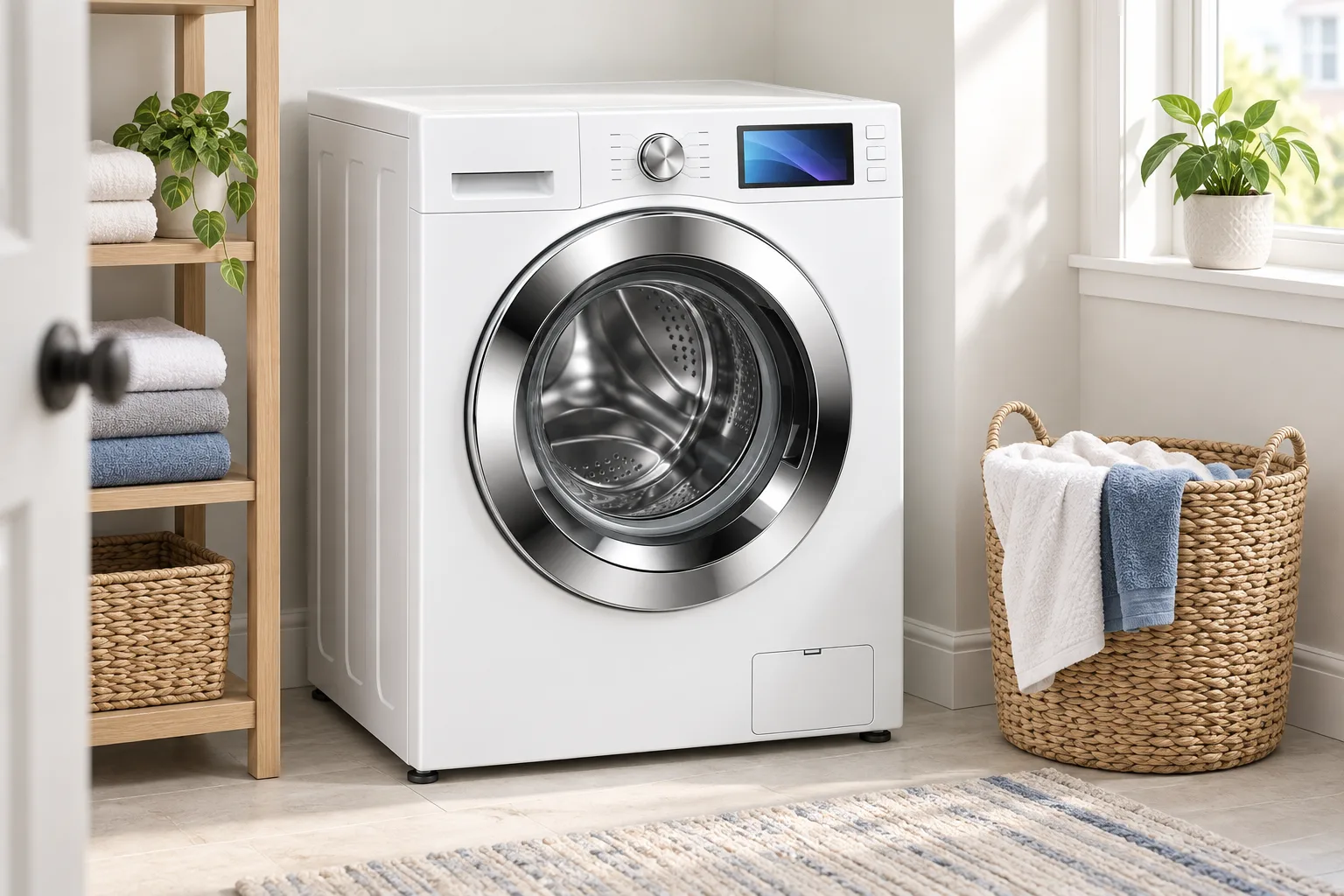
Capacity is the first number on every washer tag, and for most households it is the least interesting one. Almost every full-size front-loader sold today holds 4.5 cu ft or close to it, enough for a week of towels or a queen comforter. What separates a good machine from a frustrating one is everything else: spin speed, how much water and power it uses, whether steam is worth having, and how loud it gets in a closet next to the bedroom.
We ran the same loads through a Domio WF8 for four weeks in a small apartment with a laundry closet off the hallway, timing cycles, weighing wet laundry and measuring noise. This is what made a difference, and what did not.
Spin speed: the number that saves dryer time
The faster a washer spins at the end of a cycle, the less water stays in the clothes, and the less time they spend in the dryer. Spin speed is measured in revolutions per minute; 1,000 RPM is common on cheaper models, 1,400 RPM at the upper end. We washed the same 12 lb load of cotton towels and jeans at three settings, weighed it dry and wet, and dried it to the same point:
| Final spin | Water left in the load | Dryer time |
|---|---|---|
| 1,000 RPM | 7.4 lb | 68 min |
| 1,200 RPM | 6.6 lb | 59 min |
| 1,400 RPM | 5.8 lb | 51 min |
Seventeen minutes per load does not sound like much, but at five loads a week it is more than an hour of dryer time saved, every week. If you hang laundry to dry, it matters even more: towels spun at 1,400 RPM were dry on an indoor rack by the next morning, while the 1,000 RPM load was still damp at the hems.
Top speed is not for everything. Delicates, wool and anything with a lot of synthetic fiber wrinkles harder at full spin, so the WF8 drops the speed automatically on those cycles. Leave that alone; it is set that way for a reason.
ENERGY STAR, water and steam
An ENERGY STAR certified washer uses noticeably less water and electricity than a standard model, and most of the energy saving comes from heating less water. We put a flow meter on the inlet hose: a normal cycle with a full load used 14 gallons. An older top-loader with an agitator, which we measured for comparison in a colleague’s basement, used 31 gallons for a similar load.
The cheapest saving is the temperature dial. Modern detergents clean everyday laundry well in cold water, and a cold normal cycle costs a fraction of a hot one. Keep hot water for towels, bedding and the monthly cleaning cycle.
The trade-off is time. Using less water means the drum tumbles the laundry longer to get it clean, so a normal cycle on the WF8 took 62 minutes with a full load, against 45 minutes on the old top-loader. If you do laundry on a weeknight, that is worth knowing; the quick cycle, at about half an hour, handles a small load of lightly worn clothes well enough.
Steam is the feature people ask about most, and our answer is that it is useful, not essential. Here is what we found:
- Refreshing worn clothes: two dress shirts worn for a day came out of a 20-minute steam refresh wearable without ironing, though not crisp.
- Stains on whites: steam added to a normal cycle lifted a coffee stain that a cold wash left faintly visible.
- Everyday loads: no visible difference on jeans, T-shirts and gym clothes, and the cycle runs longer.
Noise in a small apartment
In a house, the washer lives in a basement and nobody hears it. In an apartment it is often one door away from the bedroom. We measured with a sound meter 3 ft from the machine:
- Washing: 49 dB, about the level of a quiet conversation
- Final spin at 1,400 RPM, closet door open: 71 dB
- Final spin, closet door closed, measured in the hallway: 58 dB
The spin lasts about ten minutes at the end of a cycle, so a delay start that finishes the cycle before you go to bed is worth more than any quiet mode. Vibration is a bigger problem than noise, and it is almost always installation: level the machine with its feet, check it with a level on the top, and remove the shipping bolts from the back before the first wash. A washer that walks across the floor on its first spin still has them in.
“Most people measure the width and forget the depth and the door. Measure the closet, then add room behind for the hoses and in front for the door to swing open fully.”
Tom Becker, store associate, appliances
Before you buy: measure the space
A 27-inch washer fits a standard laundry closet, but the closet also has to take the hoses, the power cord and you standing in front of it. Measure these before you order:
- The width of the opening, with at least an inch to spare on each side
- The depth from the back wall to the closet door, plus about 4 in for the hoses
- The height, if you plan to stack a dryer on top
- Every doorway and turn on the way in, including the apartment’s front door
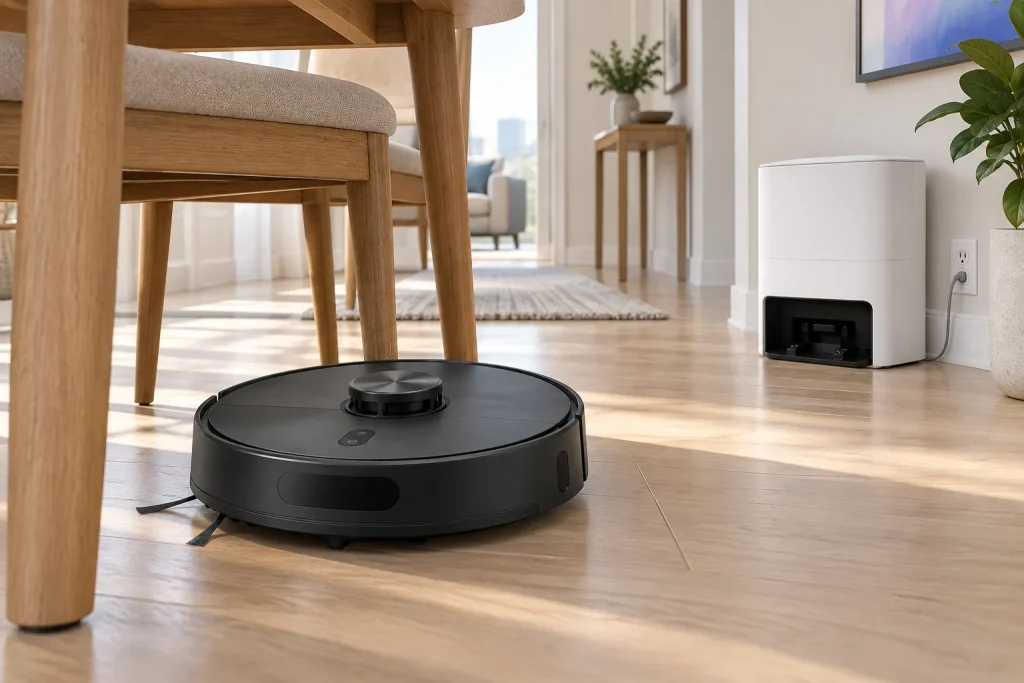
Then keep the space clean. Lint and dust gather behind and under a washer faster than anywhere else in the home, and a cordless stick vacuum such as Bryza V12 reaches it without moving the machine. If most of what ends up on your clothes is dog hair, deal with the source: our three-month review of the Bryza X9 covers how much of it a robot picks up.
-
Shop the story
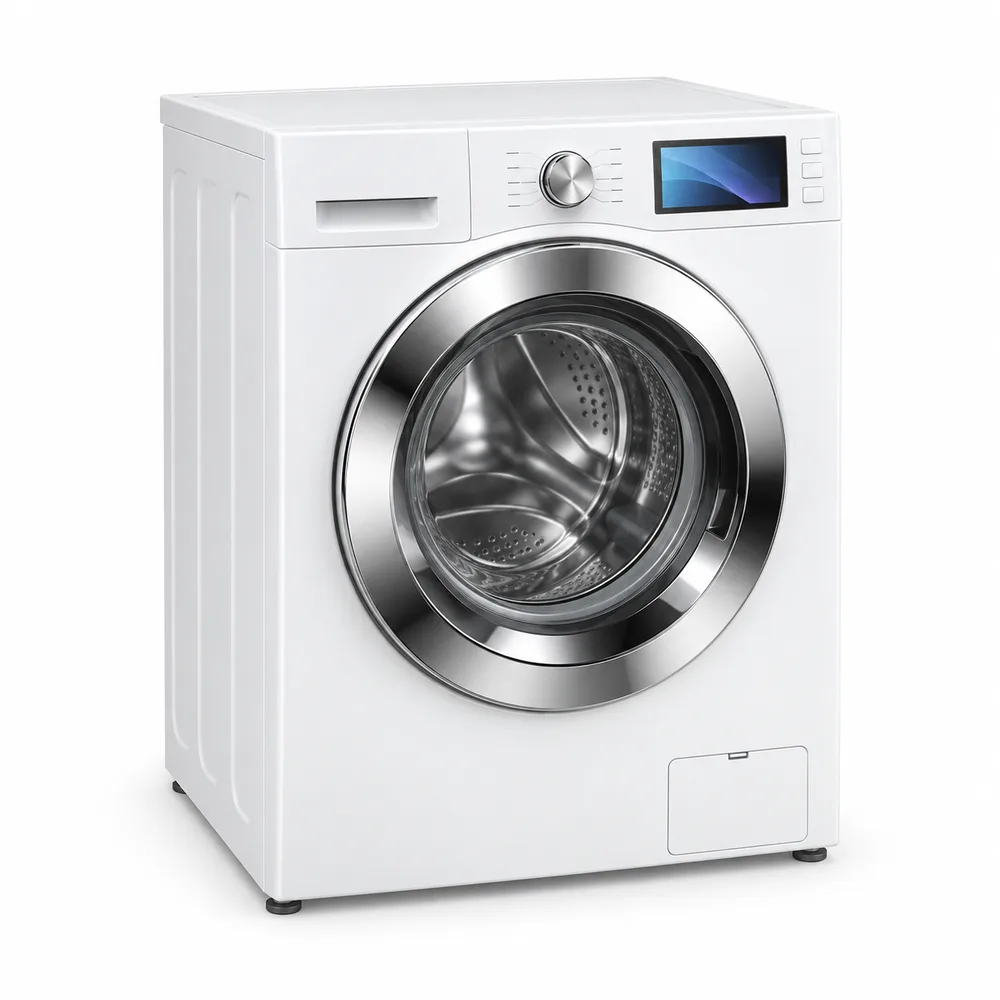
Domio WF8 4.5 cu ft Front-Load Washer with Steam – 1,400 RPM, ENERGY STAR, Stackable
$699Ships in 3–5 business days
View: Domio WF8 4.5 cu ft Front-Load Washer with Steam – 1,400 RPM, ENERGY STAR, Stackable
Quick answers
Why does my front-loader smell, and how do I stop it?
Water sits in the rubber door seal after a wash. Leave the door open a few inches between loads, wipe the seal dry once a week and run a hot cleaning cycle with nothing in the drum once a month. Using less detergent helps too.
Do I need special detergent?
Use detergent marked HE, for high-efficiency washers, and less of it than the cap suggests. Front-loaders use little water, and too much soap leaves residue on clothes and in the seal.
Can I pay for a washer over time?
Yes. Orders over $199 qualify for 12 months 0% APR, so the WF8 at $699 works out to about $58 a month for a year.